
FRENCH PLANNING AND ARCHITECTURAL SERVICES
Any size project, Anywhere in France
Building near the water in France
The Loi Littoral: What you need to know before buying near the French coast
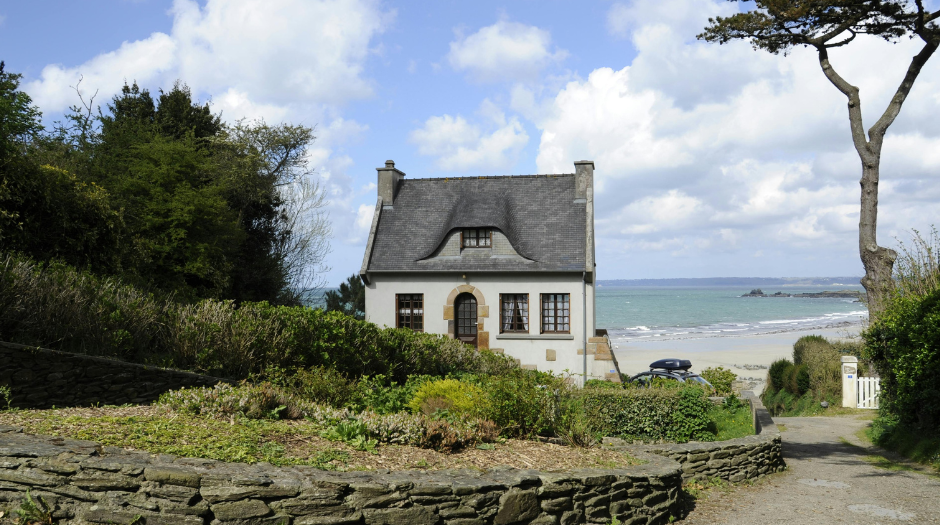
Imagine. You have spent years searching for your dream property in France, and one day – you find it: a semi-derelict though still undeniably charming stone barn for sale in a picturesque rural spot, just 500 metres from a rugged, beautiful estuary on the Brittany coast. The agence immobilière has assured you that it’s a blank canvas - with the potential for a modern glass extension. It’s a property that you just have to buy!
You go ahead and purchase the property, immediately submitting planning permission for the barn extension… a few months later you receive a flat rejection for your building permit from the authorities.
The problem: the property is affected by the Loi Littoral, a forty-year-old French environmental law designed to protect coastal areas from what is considered “inappropriate development”.
Under one of the key principles of the Loi Littoral, known as the “continuity rule”, new development should generally continue on from existing built-up areas rather than creating or extending isolated properties in open coastal land. In this case, the proposed extension falls foul of those restrictions – and the dream glass extension is no longer possible.
At French Plans, it’s our job to help people to successfully navigate the French planning system in order to make their vision a reality. In this article, we will look at the Loi Littoral in more detail; the key restrictions, what it means for renovations as well as some common misconceptions. This will help you assess any risks before you buy – enabling you to plan your project with confidence.
About the Loi Littoral
Introduced in 1986, the aim of the Loi Littoral is to preserve France’s coastline by strictly regulating and restricting development in communes bordering the sea, as well as certain estuaries, navigable rivers near the coast, and major lakes of more than 1,000 hectares. In specific areas where lake and mountain protections overlap, the requirements of the Loi Montagne may also need to be considered.
The Loi Littoral is national legislation and operates alongside local town planning documents, but can take precedence over them. So, while the local planning rules are an essential part of assessing what you can do with a property, they don’t necessarily provide the whole answer. This is particularly relevant for properties in Brittany and Normandy, as well as along the Atlantic and Mediterranean coasts, although its application is by no means limited to these areas.

What are the key restrictions?
There are two main principles that property owners and potential buyers should be particularly aware of in relation to the Loi Littoral. These constraints are there for environmental reasons as well as to protect public access.
1. The 100m "coastal strip"
Within 100 metres of the shoreline, the law places particularly strict restrictions on construction outside existing urbanised areas. Importantly, this doesn’t just apply to building a new property – it can also restrict extensions and other development associated with an existing building.
Similar protections apply around inland bodies of water (such as lakes) of more than 1,000 hectares.
But – and this is where things can become confusing – the protected coastal strip can, in some circumstances, extend beyond 100 metres and, even where it doesn’t, being more than 100 metres from the water does not automatically mean that the property is unaffected by the Loi Littoral.
2. The continuity rule (extension de l'urbanisation):
All new development in areas covered by the Loi Littoral should generally be a natural extension of existing built-up areas. Consequently, no isolated new builds in open coastal land are permissible.
This is why the barn extension in our earlier example ran into problems despite sitting 500 metres from the estuary. Its distance from the water is only part of the picture; its location in relation to existing development also matters.
Importantly, the definition of “construction” can also be interpreted widely, encompassing not only new houses, but also outbuildings, extensions and swimming pools. This means that these restrictions can be relevant even where a property is already developed.
Renovating existing properties
While authorities generally allow the renovation of existing buildings, extensions may be restricted or require specific authorisation. Because the application of the Loi Littoral can vary depending on the location and circumstances of the property, careful due diligence is essential to understand whether your plans are likely to be permitted. As we are fond of saying, “it depends”!
That’s why it’s crucial to look first at the PLU – the Plan Local d’Urbanisme. The PLU places every plot of land in a commune into one or more planning zones, ranging from agricultural to industrial, and from parkland to residential and commercial. Each zone has its own rules defining what type of construction and development may be allowed.
A change of use, known in French planning terms as a changement de destination, can also add another layer of complexity. For example, converting a barn into residential accommodation may trigger further scrutiny under the Loi Littoral, even for a long-standing structure.
Common misconceptions and pitfalls
At French Plans we have sadly seen many projects derailed by a simple truth: when it comes to French planning law, assuming you are in the right is a massive risk. These are a few of the common misconceptions:
The precedent trap: “The previous owner had planning permission – so I will too.” Unfortunately, this is not guaranteed! In France, planning history offers no guarantees. Permissions expire and planning rules can change… what this means in practice is that what was allowed yesterday may be forbidden today. This is equally true if a neighbour has done something similar to what you are planning. Again, it could be that the rules have changed, or simply that their property is subject to different planning constraints from yours.
The waterfront myth: “The law only applies to the open seafront.” The Loi Littoral actually reaches surprisingly far inland, encompassing river mouths, estuaries, tidal creeks, coastal wetlands and lakes that you might not even realise are protected.
The “constructible” illusion: Trusting that a rural coastal plot is constructible or developable just because it is marketed as “ready to build.” Estate agents may label land as constructible based on local town planning documents. However, because national legislation must also be taken into account – and can take precedence over local planning rules – the Loi Littoral could still prevent development on a plot that otherwise appears to be constructible.
So how can I know what is possible?
The Loi Littoral certainly doesn’t mean that you should avoid buying or renovating property in France’s coastal areas. Plenty of projects are entirely possible, but you can’t afford to make assumptions. Unfortunately, this is where we come back to our familiar answer: “it depends”!
As we’ve already touched on, two properties in the same commune, even relatively close to one another, can have very different development potential depending on their location, surroundings, planning history and the project being proposed.
This is why asking whether a property is “constructible” or whether it is affected by the Loi Littoral only gets you so far.
The real question is: can I carry out the project I have in mind on this particular property? And that is where proper planning due diligence becomes important.
Finding out that your dream glass extension isn’t possible is disappointing. Finding out before you buy the property is considerably less so.
Contact us
If you have a project anywhere in France, French Plans can help. With over 20 years’ experience in assessing the planning rules and constraints affecting a property we can help you understand what is realistically achievable.
Whether you already own a property or are considering buying one, we can interpret the PLU, identify potential planning issues and provide early advice before you commit to a project or purchase.
As architects as well as planning consultants, we can also provide early design input to help unlock what may be possible within the restrictions. Please get in touch if you would like to know more.
+33 (0) 6 75 05 36 86
